
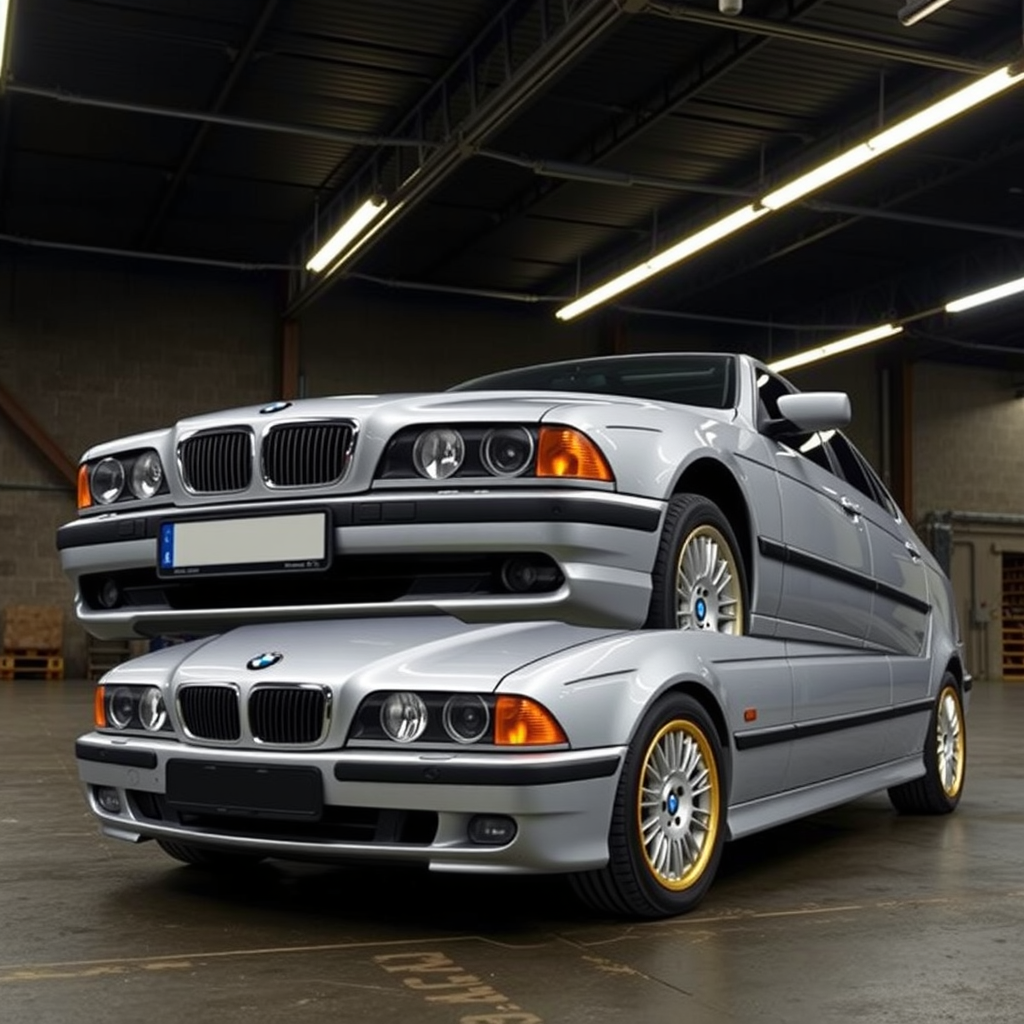
BMW 5 Series wheel fitment — IV E39
BMW 5 Series wheel fitment
BMW 5 Series wheel fitment for the BMW 5 Series IV (E39) (1996–2004): the factory PCD, centre bore and bolt spec, then the aftermarket width and offset window we fit to.
| Bolt pattern (PCD) | 5x120 |
| Centre bore | 74.1 mm |
| Bolt / thread | M12 x 1.5 (bolts) |
| Wheel-bolt torque | 115 Nm |
| Seat type | tapered |
| Factory setup | square |
| TPMS | direct |
Aftermarket wheel sizes — read per position:
| Position | Width | Offset |
|---|---|---|
| Front | 6J–7.5J | ET13–ET31 |
Width and offset move together: roughly 8 to 10 ET more for every extra 1J keeps the wheel inside the arch. Final offset and any spacer come from the fit-check.
UK popularity & demand
Based on DfT VEH0124 vehicle-parc data (2025), there are approximately 196,854 BMW 5 Series on UK roads, placing it in the top 2% of car models by volume across our fitment database.
With that many on the road, BMW 5 Series wheel fitment is a spec fitters see constantly. We keep it current for that reason.
Source: DfT/DVLA licensed-vehicle statistics (VEH0124), matched to the AIWheelTech fitment database.
Overview
The BMW E39 is the fourth generation of the BMW 5 Series range, manufactured from 1996 to 2004. It was launched as a saloon and later introduced as a Touring (station wagon) model in 1996. The car was produced at Dingolfing in Germany, Jakarta in Indonesia via CKD assembly, and Kaliningrad in Russia by Avtotor. Compared to its predecessor, the E34, the E39 featured increased use of aluminium in chassis components, a four-cylinder diesel engine option for the first time, and rack-and-pinion steering on four- and six-cylinder models. It was positioned as an executive car, replacing the E34 and succeeded by the E60 5 Series.
Dimensions
| Length | 4,775 to 4,805 mm |
| Width | 1,800 mm |
| Height | 1,435 to 1,445 mm |
| Wheelbase | 2,830 mm |
| Kerb weight | 1,485 to 1,875 kg |
Source: BMW E39, de.wikipedia.org.
Body styles & production
| Body styles | 4-door saloon, 5-door estate (Touring) |
| Produced | 1996–2004 |
Engines & drivetrain
| Variant | Engine | Fuel | Power | Drive, years |
|---|---|---|---|---|
| 520i | 1,991 cc, M52B20 | petrol | 110 kW (150 PS) | 1995 to 1998 |
| 520i | 1,991 cc, M52B20TU | petrol | 110 kW (150 PS) | 1998 to 2000 |
| 520i | 2,171 cc, M54B22 | petrol | 125 kW (170 PS) | 2000 to 2004 |
| 523i | 2,494 cc, M52B25 | petrol | 125 kW (170 PS) | 1995 to 1998 |
| 523i | 2,494 cc, M52B25TU | petrol | 125 kW (170 PS) | 1998 to 2000 |
| 525i | 2,494 cc, M54B25 | petrol | 141 kW (192 PS) | 2000 to 2004 |
| 528i | 2,793 cc, M52B28 | petrol | 142 kW (193 PS) | 1995 to 1998 |
| 528i | 2,793 cc, M52B28TU | petrol | 142 kW (193 PS) | 1998 to 2000 |
| 530i | 2,979 cc, M54B30 | petrol | 170 kW (231 PS) | 2000 to 2004 |
| 535i | 3,498 cc, M62B35 | petrol | 173 kW (235 PS) | 1996 to 1998 |
| 535i | 3,498 cc, M62B35TU | petrol | 180 kW (245 PS) | 1998 to 2003 |
| 540i | 4,398 cc, M62B44 | petrol | 210 kW (286 PS) | 1996 to 1998 |
| 540i | 4,398 cc, M62B44TU | petrol | 210 kW (286 PS) | 1998 to 2004 |
| M5 | 4,941 cc, S62B50 | petrol | 294 kW (400 PS) | 1998 to 2003 |
| 520d | 1,951 cc, M47D20 | diesel | 100 kW (136 PS) | 2000 to 2003 |
| 525td | 2,497 cc, M51D25 | diesel | 85 kW (115 PS) | 1996 to 2000 |
| 525tds | 2,497 cc, M51D25TU | diesel | 105 kW (143 PS) | 1996 to 2000 |
| 525d | 2,497 cc, M57D25 | diesel | 120 kW (163 PS) | 2000 to 2004 |
| 530d | 2,926 cc, M57D30 | diesel | 135 kW (184 PS) | 1998 to 2000 |
| 530d | 2,926 cc, M57D30 | diesel | 142 kW (193 PS) | 2000 to 2004 |
| B10 3,2 | 3,152 cc | 191 kW (260 PS) | 1997 to 1998 | |
| B10 3,3 | 3,298 cc | 206 kW (280 PS) | 1999 to 2003 | |
| B10 V8 | 4,619 cc | 250 kW (340 PS) | 1997 to 1998 | |
| B10 V8 | 4,619 cc | 255 kW (347 PS) | 1998 to 2000 | |
| B10 V8 | 4,619 cc | 255 kW (347 PS) | 2000 to 2002 | |
| B10 V8 S | 4,837 cc | 276 kW (375 PS) | 2002 to 2004 | |
| D10 Biturbo | 2,926 cc | 180 kW (245 PS) | 2000 to 2003 |
Source: BMW E39, de.wikipedia.org.
Performance
| Variant | Power | 0 to 62 mph (0 to 100 km/h) | Top speed |
|---|---|---|---|
| 520i | 110 kW (150 PS) | 10.2 s | 210 to 220 km/h (130 to 137 mph) |
| 520i | 110 kW (150 PS) | 10.2 s | 210 to 220 km/h (130 to 137 mph) |
| 520i | 125 kW (170 PS) | 9.1 s | 220 to 226 km/h (137 to 140 mph) |
| 523i | 125 kW (170 PS) | 8.5 s | 226 to 228 km/h (140 to 142 mph) |
| 523i | 125 kW (170 PS) | 8.5 s | 226 to 228 km/h (140 to 142 mph) |
| 525i | 141 kW (192 PS) | 8.1 s | 232 to 238 km/h (144 to 148 mph) |
| 528i | 142 kW (193 PS) | 7.5 s | 234 to 236 km/h (145 to 147 mph) |
| 528i | 142 kW (193 PS) | 7.5 s | 235 to 240 km/h (146 to 149 mph) |
| 530i | 170 kW (231 PS) | 7.1 s | 244 to 250 km/h (152 to 155 mph) |
| 535i | 173 kW (235 PS) | 7 s | 244 to 247 km/h (152 to 153 mph) |
| 535i | 180 kW (245 PS) | 6.9 s | 247 to 250 km/h (153 to 155 mph) |
| 540i | 210 kW (286 PS) | 6.2 s | 250 km/h (155 mph) |
| 540i | 210 kW (286 PS) | 6.2 s | 250 km/h (155 mph) |
| M5 | 294 kW (400 PS) | 5.3 s | 250 km/h (155 mph) |
| 520d | 100 kW (136 PS) | 10.6 s | 206 km/h (128 mph) |
| 525td | 85 kW (115 PS) | 11.9 s | 198 km/h (123 mph) |
| 525tds | 105 kW (143 PS) | 10.4 s | 205 to 211 km/h (127 to 131 mph) |
| 525d | 120 kW (163 PS) | 8.9 s | 219 km/h (136 mph) |
| 530d | 135 kW (184 PS) | 8 s | 225 km/h (140 mph) |
| 530d | 142 kW (193 PS) | 7.8 s | 230 km/h (143 mph) |
| B10 3,2 | 191 kW (260 PS) | 6.5 s | 252 to 260 km/h (157 to 162 mph) |
| B10 3,3 | 206 kW (280 PS) | 6.3 s | 256 to 262 km/h (159 to 163 mph) |
| B10 V8 | 250 kW (340 PS) | 5.9 s | 268 to 275 km/h (167 to 171 mph) |
| B10 V8 | 255 kW (347 PS) | 5.9 s | 269 to 279 km/h (167 to 173 mph) |
| B10 V8 | 255 kW (347 PS) | 5.5 s | 269 to 279 km/h (167 to 173 mph) |
| B10 V8 S | 276 kW (375 PS) | 5.4 s | 273 to 284 km/h (170 to 176 mph) |
| D10 Biturbo | 180 kW (245 PS) | 7.2 s | 251 to 254 km/h (156 to 158 mph) |
Source: BMW E39, de.wikipedia.org.
Trim levels
Factory colours
History & notable variants
Development began in 1993 with Joji Nagashima's design selected in June 1992. The model premiered at the Frankfurt Motor Show in September 1995 and was available for sale from December of that year. A high-performance variant, the E39 M5 saloon, debuted in 1998 featuring a V8 engine, marking a shift from previous inline-six engines. Alpina also produced several variants including the B10 series with various petrol and diesel options.
Reliability & owner notes
- Pros: Increased use of aluminium in chassis components; First BMW 5 Series with a four-cylinder diesel engine option; Rack-and-pinion steering on four- and six-cylinder models
- Cons: Not available with all-wheel drive