
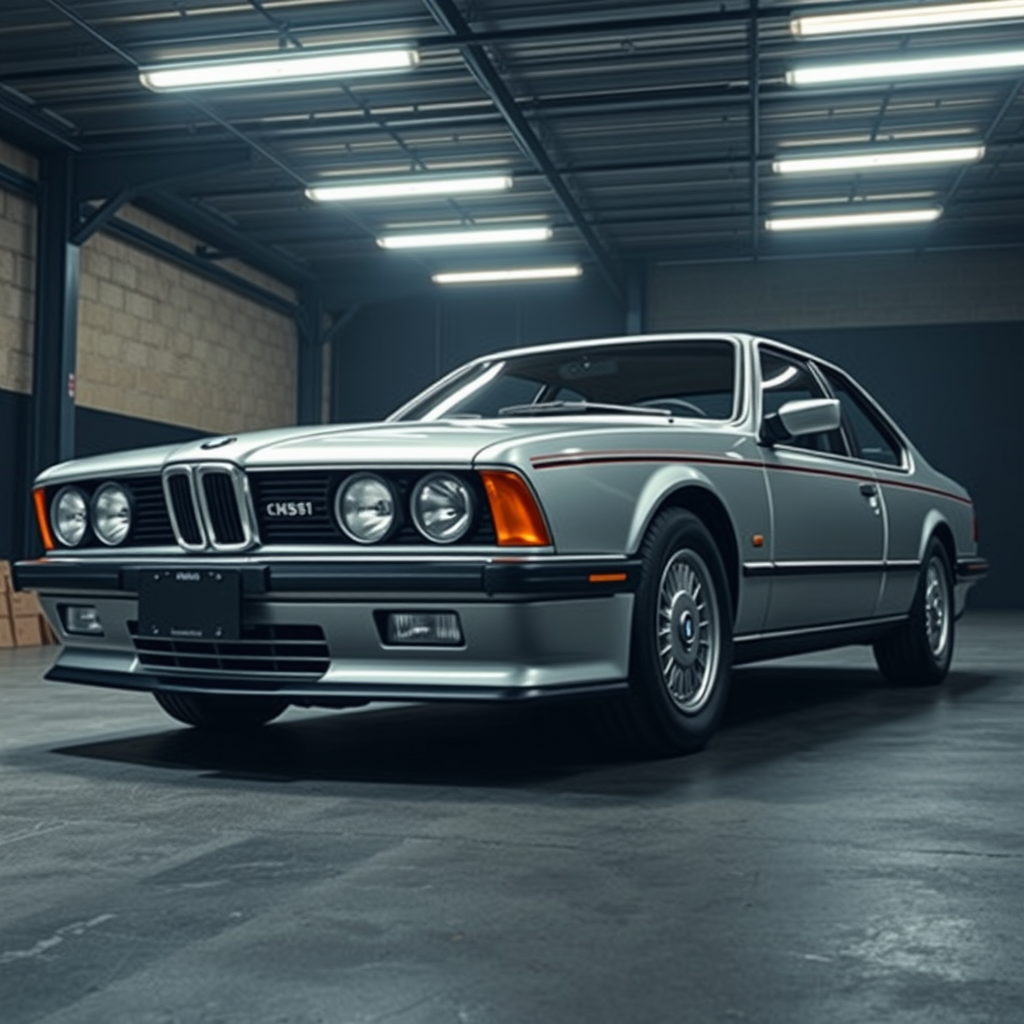
BMW 6 Series wheel fitment — I E24
Overview
The BMW 6 Series I (E24) is the first generation of grand tourer cars produced from January 1976 to April 1989, replacing the E9 coupé. It was manufactured in West Germany by Karmann and later Dingolfing, featuring a 2-door coupé body style with petrol straight-six engines. The E24 shared many parts with the BMW 5 Series (E12) and received an update in 1982 incorporating elements from the new E28 5 Series.
BMW 6 Series wheel fitment
Start with the hub. The BMW 6 Series I (E24) spec table gives the bolt pattern and bore; the second table is the aftermarket window for BMW 6 Series wheel fitment.
| Bolt pattern (PCD) | 5x120 |
| Centre bore | 72.6 mm |
| Bolt / thread | M12 x 1.5 (bolts) |
| Seat type | tapered |
| Factory setup | square |
| TPMS | none |
Aftermarket wheel sizes — read per position:
| Position | Width | Offset |
|---|---|---|
| Front | 6.5J–8J | ET5–ET38 |
As a rule, each extra 1J of width wants roughly +8 to 10 ET to keep the wheel tucked. The exact offset and any spacer are confirmed by the fit-check.
UK popularity & demand
Based on DfT VEH0124 vehicle-parc data (2025), there are approximately 19,390 BMW 6 Series on UK roads, placing it in the top 11% of car models by volume across our fitment database.
That makes BMW 6 Series wheel fitment a high-demand spec to keep in stock. It is one reason we track it here.
Source: DfT/DVLA licensed-vehicle statistics (VEH0124), matched to the AIWheelTech fitment database.
Engines & drivetrain
| Variant | Engine | Fuel | Power | Drive, years |
|---|---|---|---|---|
| 628CSi | M30B28, SOHC I6, 2,788 cc | 135 kW (184 PS) | 1979 to 1987 | |
| 630CS | M30B30V, SOHC I6, 2,986 cc | 136 kW (185 PS) | 1976 to 1979 | |
| 633CSi | M30B32, SOHC I6, 3,210 cc | 147 kW (200 PS) | 1976 to 1979 | |
| 633CSi | M30B32, SOHC I6, 3,210 cc | 145 kW (197 PS) | 1979 to 1984 | |
| 635CSi | M90, SOHC I6, 3,453 cc | 160 kW (218 PS) | 1978 to 1982 | |
| 635CSi | M30B34, SOHC I6, 3,430 cc | 160 kW (218 PS) | 1982 to 1987 | |
| 635CSi | M30B34, SOHC I6, 3,430 cc | 136 kW (185 PS) | 1985 to 1987 | |
| 635CSi | M30B35, SOHC I6, 3,430 cc | 162 kW (220 PS) | 1987 to 1989 | |
| 635CSi | M30B35, SOHC I6, 3,430 cc | 155 kW (211 PS) | 1987 to 1989 | |
| M635CSi | M88/3, DOHC I6, 3,453 cc | 210 kW (286 PS) | 1984 to 1989 | |
| M635CSi | S38B35, DOHC I6, 3,453 cc | 191 kW (260 PS) | 1986 to 1989 | |
| 630CSi | M30B30, SOHC I6, 2,986 cc | 176 hp | 1977 to 1978 | |
| 633CSi | M30B32, SOHC I6, 3,210 cc | 177 hp | 1978 to 1979 | |
| 633CSi | M30B32, SOHC I6, 3,210 cc | 174 hp | 1980 to 1981 | |
| 633CSi | M30B32, SOHC I6, 3,210 cc | 181 hp | 1982 to 1984 | |
| 635CSi / L6 | M30B34, SOHC I6, 3,430 cc | 182 hp | 1985 to 1987 | |
| 635CSi / L6 | M30B35, SOHC I6, 3,430 cc | 208 hp | 1988 to 1989 | |
| M6 | S38B35, DOHC I6, 3,453 cc | 256 hp | 1987 to 1989 |
Source: BMW 6 Series (E24), en.wikipedia.org.
Dimensions
| Length | 4,755 to 4,923 mm |
| Width | 1,725 mm |
| Height | 1,365 mm |
| Wheelbase | 2,630 mm |
| Kerb weight | 1,450 to 1,619 kg |
Source: BMW 6 Series (E24), en.wikipedia.org.
Body styles & production
| Body styles | 2-door coupé |
| Produced | 1976–1990 |
| Units produced | 86,216 |
Trim levels
Factory colours
History & notable variants
The E24 was designed by Paul Bracq, featuring a B pillar unlike its predecessor. Production began at Karmann before moving to Dingolfing. Notable variants include the M635CSi (1983) and North American M6 (1987). The car received a facelift in 1982 with updated styling, engines, chassis, suspension, electronics, and interior elements from the E28 5 Series. It was succeeded by the BMW 6 Series II (E63) after a 16-year hiatus.
Reliability & owner notes
- Pros: Stylish design; powerful straight-six engines; shared parts with popular 5 Series
- Cons: Limited body style options; increased weight due to safety regulations in North America