
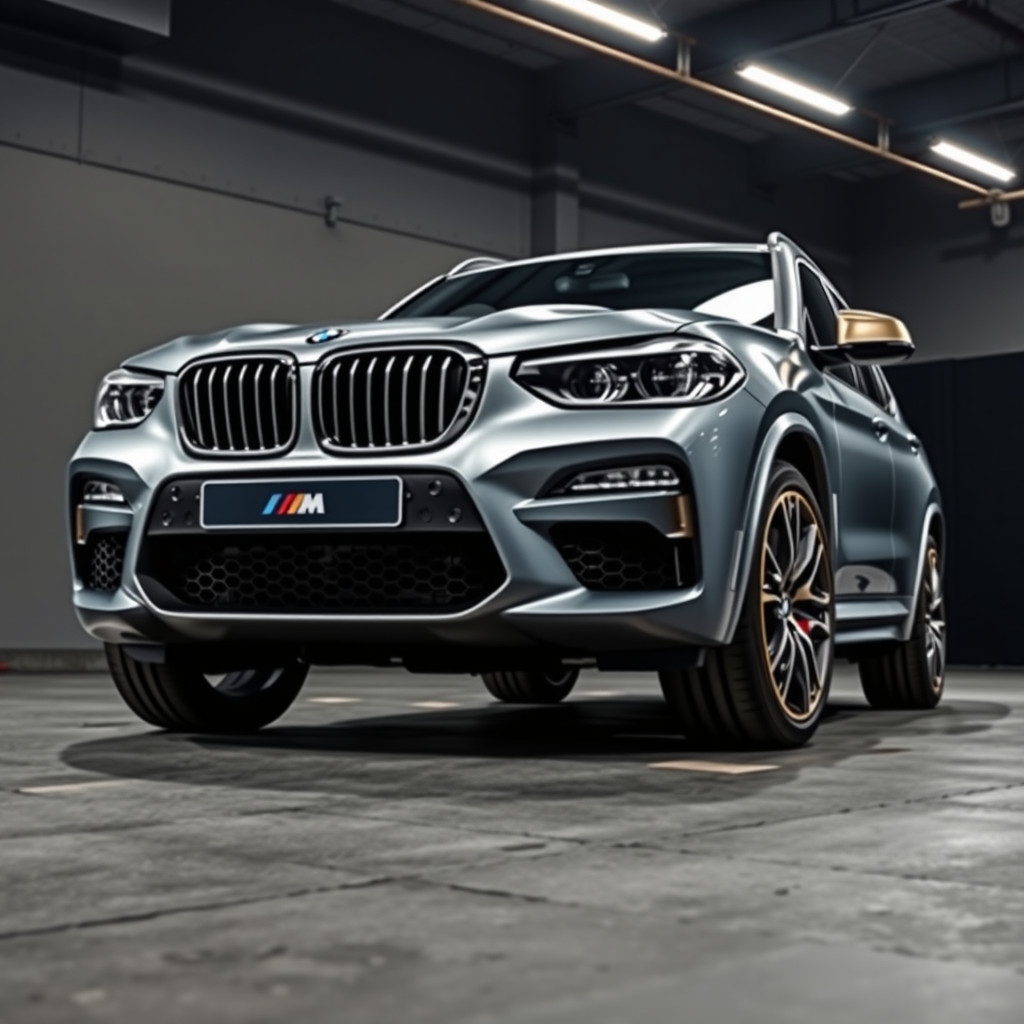
BMW X3 M wheel fitment — F97 LCI
Overview
The third-generation BMW X3 F97 is a compact luxury crossover SUV manufactured by BMW since 2017. It was designed to offer improved performance and technology over its predecessor, the second generation (F25). The production of this model began in 2017 at BMW's Rosslyn plant in South Africa alongside the Spartanburg plant in the USA after a major upgrade for X3 production capacity. This generation features advanced drivetrains including petrol variants with the powerful B58 engine and diesel options, as well as an electric variant (BMW iX3). The F97 version introduced the 3.0 L S58 engine specifically for the M model in 2019.
History & notable variants
The third-generation X3 was unveiled in June 2017 and marked a significant upgrade from its predecessor, featuring enhanced technology such as gesture control (optional), LED lighting, and BMW iDrive 6.0 system with a large touch-screen monitor for navigation systems. The M variant of the F97 model was introduced in 2019, equipped with the powerful S58 engine.
BMW X3 M wheel fitment
Everything below is what the fit-check uses for BMW X3 M wheel fitment: the factory bolt spec first, then the width and offset window that clears the arches and the brakes on the BMW X3 M F97 LCI.
| Bolt pattern (PCD) | 5x112 |
| Centre bore | 66.6 mm |
| Bolt / thread | M14 x 1.25 (bolts) |
| Wheel-bolt torque | 140 Nm |
| Seat type | tapered |
| Factory setup | staggered |
| TPMS | direct |
| Run-flat | Yes |
Aftermarket wheel sizes — read per position:
| Position | Width | Offset |
|---|---|---|
| Front | 8.5J–9.5J | ET7–ET30 |
| Rear (staggered) | 10J–11J | ET24–ET44 |
As a rule, each extra 1J of width wants roughly +8 to 10 ET to keep the wheel tucked. The exact offset and any spacer are confirmed by the fit-check.
Engines & drivetrain
| Variant | Engine | Fuel | Power | Drive, years |
|---|---|---|---|---|
| sDrive20i | 1,998 cc, Motorkenndaten | petrol | 135 kW (184 PS) | RWD, 2017 to 2024 |
| xDrive20i | 1,998 cc, Motorkenndaten | petrol | 135 kW (184 PS) | xDrive, 2017 to 2021 |
| xDrive20i | 1,998 cc, Motorkenndaten | petrol | 135 kW (184 PS) | xDrive, 2021 to 2024 |
| xDrive28i | 1,998 cc, Motorkenndaten | petrol | 165 kW (224 PS) | xDrive |
| xDrive30i | 1,998 cc, Motorkenndaten | petrol | 180 kW (245 PS) | xDrive, 2021 to 2024 |
| xDrive30i | 1,998 cc, Motorkenndaten | petrol | 185 kW (252 PS) | xDrive, 2017 to 2021 |
| M40i | 2,998 cc, Motorkenndaten | petrol | 260 kW (354 PS) | AWD, 2018 to 2019 |
| M40i | 2,998 cc, Motorkenndaten | petrol | 265 kW (360 PS) | AWD, 2017 to 2018 |
| M40i | 2,998 cc, Motorkenndaten | petrol | 265 kW (360 PS) | AWD, 2019 to 2021 |
| M40i | 2,998 cc, Motorkenndaten | petrol | 265 kW (360 PS) | AWD, 2021 to 2024 |
| M [F97] | 2,993 cc, Motorkenndaten | petrol | 353 kW (480 PS) | AWD, 2019 to 2021 |
| M Competition [F97] | 2,993 cc, Motorkenndaten | petrol | 375 kW (510 PS) | AWD, 2019 to 2021 |
| M Competition [F97] | 2,993 cc, Motorkenndaten | petrol | 375 kW (510 PS) | AWD, 2021 to 2024 |
| xDrive30e | 1,998 cc, Motorkenndaten | hybrid | 215 kW (292 PS) | xDrive, 2019 to 2024 |
| sDrive18d | 1,995 cc, Motorkenndaten | diesel | 110 kW (150 PS) | RWD |
| xDrive20d | 1,995 cc, Motorkenndaten | diesel | 140 kW (190 PS) | xDrive, 2017 to 2021 |
| xDrive20d | 1,995 cc, Motorkenndaten | diesel | 140 kW (190 PS) | xDrive, 2021 to 2024 |
| xDrive25d | 1,995 cc, Motorkenndaten | diesel | 170 kW (231 PS) | xDrive, 2018 to 2019 |
| xDrive30d | 2,993 cc, Motorkenndaten | diesel | 195 kW (265 PS) | xDrive, 2017 to 2019 |
| xDrive30d | 2,993 cc, Motorkenndaten | diesel | 210 kW (286 PS) | xDrive, 2020 to 2021 |
| xDrive30d | 2,993 cc, Motorkenndaten | diesel | 210 kW (286 PS) | xDrive, 2021 to 2024 |
| M40d | 2,993 cc, Motorkenndaten | diesel | 240 kW (326 PS) | AWD, 2018 to 2019 |
| M40d | 2,993 cc, Motorkenndaten | diesel | 250 kW (340 PS) | AWD, 2020 to 2021 |
| M40d | 2,993 cc, Motorkenndaten | diesel | 250 kW (340 PS) | AWD, 2021 to 2024 |
| iX3 | HA0001N0 | electric | 210 kW (286 PS) | RWD, 2021 to 2025 |
Source: BMW G01, de.wikipedia.org.
Performance
| Variant | Power | 0 to 62 mph (0 to 100 km/h) | Top speed |
|---|---|---|---|
| sDrive20i | 135 kW (184 PS) | 8.3 s | |
| xDrive20i | 135 kW (184 PS) | 8.3 s | |
| xDrive20i | 135 kW (184 PS) | 8.4 s | |
| xDrive28i | 165 kW (224 PS) | 7.6 s | |
| xDrive30i | 180 kW (245 PS) | 6.6 s | |
| xDrive30i | 185 kW (252 PS) | 6.3 s | |
| M40i | 260 kW (354 PS) | 4.8 s | |
| M40i | 265 kW (360 PS) | 4.8 s | |
| M40i | 265 kW (360 PS) | 4.8 s | |
| M40i | 265 kW (360 PS) | 4.9 s | |
| M [F97] | 353 kW (480 PS) | 4.2 s | |
| M Competition [F97] | 375 kW (510 PS) | 4.1 s | |
| M Competition [F97] | 375 kW (510 PS) | 3.8 s | |
| xDrive30e | 215 kW (292 PS) | 6.1 s | |
| sDrive18d | 110 kW (150 PS) | 9.5 to 9.7 s | |
| xDrive20d | 140 kW (190 PS) | 8 s | |
| xDrive20d | 140 kW (190 PS) | 7.9 s | |
| xDrive25d | 170 kW (231 PS) | 6.8 s | |
| xDrive30d | 195 kW (265 PS) | 5.8 s | |
| xDrive30d | 210 kW (286 PS) | 5.7 s | |
| xDrive30d | 210 kW (286 PS) | 5.7 s | |
| M40d | 240 kW (326 PS) | 4.9 s | |
| M40d | 250 kW (340 PS) | 4.9 s | |
| M40d | 250 kW (340 PS) | 4.9 s | |
| iX3 | 210 kW (286 PS) | 6.8 s |
Source: BMW G01, de.wikipedia.org.
UK popularity & demand
Based on DfT VEH0124 vehicle-parc data (2025), there are approximately 123,411 BMW X3 M range on UK roads, placing it in the top 3% of car models by volume across our fitment database.
With that many on the road, BMW X3 M wheel fitment is a spec fitters see constantly. We keep it current for that reason.
Source: DfT/DVLA licensed-vehicle statistics (VEH0124), matched to the AIWheelTech fitment database.
Dimensions
| Length | 4,708 to 4,734 mm |
| Width | 1,891 to 1,897 mm |
| Height | 1,667 to 1,676 mm |
| Wheelbase | 2,864 mm |
| Kerb weight | 1,860 to 2,085 kg |
Source: BMW G01, de.wikipedia.org; EU type-approval data (EEA).
Body styles & production
| Body styles | Kombi |
| Produced | 2021–2024 |
Factory colours
Trim levels
Reliability & owner notes
- Pros: Advanced technology features, powerful engine options, improved safety ratings
- Cons: Higher price point compared to previous generation, limited availability of certain trims in some markets