
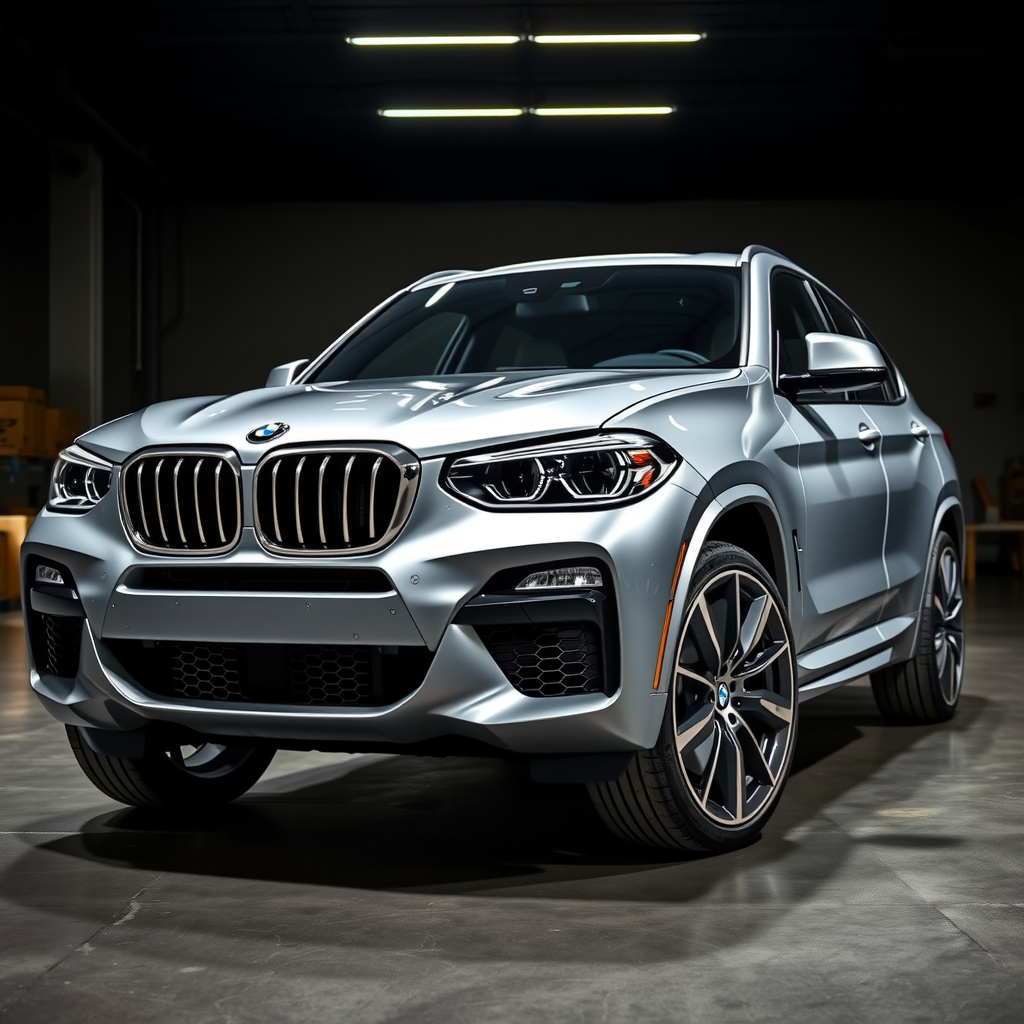
BMW X4 wheel fitment — G02
Overview
The BMW X4 G02 is a compact luxury crossover SUV manufactured by BMW from 2018 to 2021 as part of its second generation. It shares its platform and basic styling elements with the third-generation BMW X3, featuring dual ball joint front axle and five-link rear axle suspension on BMW's Cluster Architecture (CLAR) platform. Compared to its predecessor, it is lighter by 50 kg and has a slightly larger footprint.
BMW X4 wheel fitment
Start with the hub. The BMW X4 G02 spec table gives the bolt pattern and bore; the second table is the aftermarket window for BMW X4 wheel fitment.
| Bolt pattern (PCD) | 5x112 |
| Centre bore | 66.6 mm |
| Bolt / thread | M14 x 1.25 (bolts) |
| Wheel-bolt torque | 140 Nm |
| Seat type | tapered |
| Factory setup | square |
| TPMS | direct |
| Run-flat | Yes |
Aftermarket wheel sizes — read per position:
| Position | Width | Offset |
|---|---|---|
| Front | 8J–10J | ET12–ET42 |
Width and offset move together: roughly 8 to 10 ET more for every extra 1J keeps the wheel inside the arch. Final offset and any spacer come from the fit-check.
UK popularity & demand
Based on DfT VEH0124 vehicle-parc data (2025), there are approximately 20,518 BMW X4 on UK roads, placing it in the top 10% of car models by volume across our fitment database.
That makes BMW X4 wheel fitment a high-demand spec to keep in stock. It is one reason we track it here.
Source: DfT/DVLA licensed-vehicle statistics (VEH0124), matched to the AIWheelTech fitment database.
Engines & drivetrain
| Variant | Engine | Fuel | Power | Drive, years |
|---|---|---|---|---|
| xDrive20i | Ottomotor, 1,998 cc | petrol | 135 kW (184 PS) | xDrive, 2018 to 2021 |
| xDrive20i | Ottomotor, 1,998 cc | petrol | 135 kW (184 PS) | xDrive, 2021 to 2023 |
| xDrive20i | Ottomotor, 1,998 cc | petrol | 135 kW (184 PS) | xDrive, 2023 to 2025 |
| xDrive30i | Ottomotor, 1,998 cc | petrol | 180 kW (245 PS) | xDrive, 2023 to 2025 |
| xDrive30i | Ottomotor, 1,998 cc | petrol | 180 kW (245 PS) | xDrive, 2021 to 2024 |
| xDrive30i | Ottomotor, 1,998 cc | petrol | 185 kW (252 PS) | xDrive, 2018 to 2021 |
| M40i | Ottomotor, 2,998 cc | petrol | 260 kW (354 PS) | AWD, 2018 to 2019 |
| M40i | Ottomotor, 2,998 cc | petrol | 265 kW (360 PS) | AWD, 2019 to 2021 |
| M40i | Ottomotor, 2,998 cc | petrol | 265 kW (360 PS) | AWD, 2021 to 2024 |
| M40i | Ottomotor, 2,998 cc | petrol | 265 kW (360 PS) | AWD, 2024 to 2025 |
| M [F98] | Ottomotor, 2,993 cc | petrol | 353 kW (480 PS) | AWD, 2019 to 2021 |
| M Competition [F98] | Ottomotor, 2,993 cc | petrol | 375 kW (510 PS) | AWD, 2019 to 2021 |
| M Competition [F98] | Ottomotor, 2,993 cc | petrol | 375 kW (510 PS) | AWD, 2021 to 2024 |
| M Competition [F98] | Ottomotor, 2,993 cc | petrol | 375 kW (510 PS) | AWD, 2024 to 2025 |
| xDrive20d | Dieselmotor, 1,995 cc | diesel | 140 kW (190 PS) | xDrive, 2018 to 2021 |
| xDrive20d | Dieselmotor, 1,995 cc | diesel | 140 kW (190 PS) | xDrive, 2021 to 2024 |
| xDrive20d | Dieselmotor, 1,995 cc | diesel | 140 kW (190 PS) | xDrive, 2024 to 2025 |
| xDrive25d | Dieselmotor, 1,995 cc | diesel | 170 kW (231 PS) | xDrive, 2018 to 2019 |
| xDrive30d | Dieselmotor, 2,993 cc | diesel | 195 kW (265 PS) | xDrive, 2018 to 2020 |
| xDrive30d | Dieselmotor, 2,993 cc | diesel | 210 kW (286 PS) | xDrive, 2020 to 2021 |
| xDrive30d | Dieselmotor, 2,993 cc | diesel | 210 kW (286 PS) | xDrive, 2021 to 2024 |
| xDrive30d | Dieselmotor, 2,993 cc | diesel | 210 kW (286 PS) | xDrive, 2024 to 2025 |
| M40d | Dieselmotor, 2,993 cc | diesel | 240 kW (326 PS) | AWD, 2018 to 2020 |
| M40d | Dieselmotor, 2,993 cc | diesel | 250 kW (340 PS) | AWD, 2020 to 2021 |
| M40d | Dieselmotor, 2,993 cc | diesel | 250 kW (340 PS) | AWD, 2021 to 2024 |
| M40d | Dieselmotor, 2,993 cc | diesel | 250 kW (340 PS) | AWD, 2024 to 2025 |
Source: BMW G02, de.wikipedia.org.
Dimensions
| Length | 4,733 to 4,758 mm |
| Width | 1,918 to 1,938 mm |
| Height | 1,618 to 1,621 mm |
| Wheelbase | 2,864 mm |
| Kerb weight | 1,800 to 2,065 kg |
Source: BMW G02, de.wikipedia.org; EU type-approval data (EEA).
Body styles & production
| Body styles | Kombilimousine |
| Produced | 2018–2021 |
Trim levels
Factory colours
History & notable variants
The second generation of the BMW X4 was revealed online in February 2018 as the successor to the F26 model, with sales commencing in July 2018. Notable for its performance variants such as the xDriveM40i and xDriveM40d, it also introduced a mild hybrid system on diesel models starting from spring 2020. The X4 M and X4 M Competition were launched in 2019, marking the first time an X4 received an M version.
Reliability & owner notes
- Pros: Stylish design, powerful performance options, advanced technology features
- Cons: Limited practicality due to sloping roofline, higher maintenance costs compared to standard SUV models