
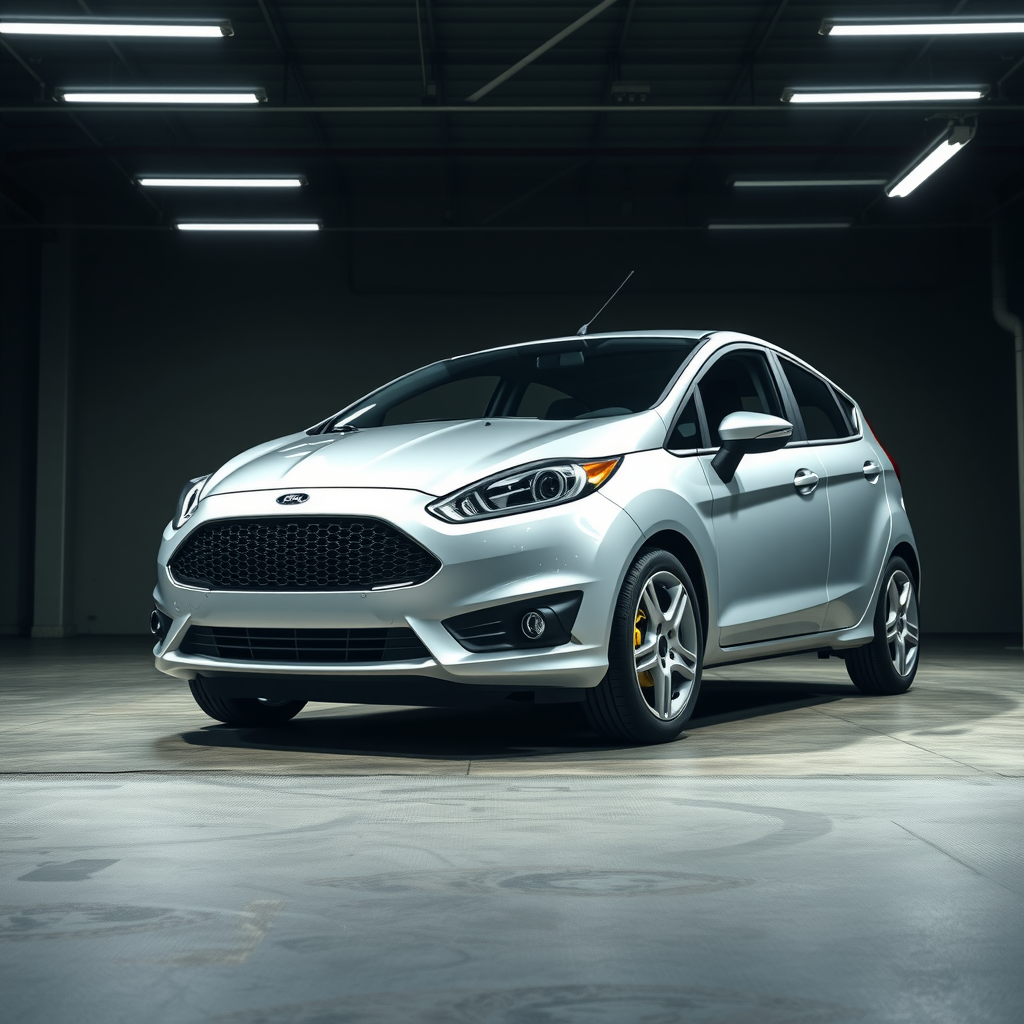
Ford Fiesta wheel fitment — Vii JA8, JR8
Overview
The Ford Fiesta (Vii) JA8, JR8 is a subcompact car in the supermini segment, developed by Ford's European operations. It was positioned below the Escort and later the Focus in Ford’s lineup. This generation of the Fiesta saw production from 2011 to 2019 in North America, though its global production timeline may differ. The VII generation marked a significant evolution with modernized styling, improved technology, and enhanced fuel efficiency compared to its predecessor. It was manufactured across various plants globally including Europe, China, India, and South Africa.
Ford Fiesta wheel fitment
Ford Fiesta wheel fitment for the Ford Fiesta (Vii) JA8, JR8 (2008–2016): the factory PCD, centre bore and bolt spec, then the aftermarket width and offset window we fit to.
| Bolt pattern (PCD) | 4x10⁸ |
| Centre bore | 63.4 mm |
| Bolt / thread | M12x1.5 (nuts) |
| Wheel-bolt torque | 100 Nm |
| Seat type | tapered |
| Factory setup | square |
| TPMS | direct |
Aftermarket wheel sizes — read per position:
| Position | Width | Offset |
|---|---|---|
| Front | 5.5J–8J | ET25–ET48 |
As a rule, each extra 1J of width wants roughly +8–10 ET to keep the wheel tucked. The exact offset and any spacer are confirmed by the fit-check.
UK popularity & demand
Based on DfT VEH0124 vehicle-parc data (2025), there are approximately 1,275,096 Ford Fiesta on UK roads, placing it in the top 1% of car models by volume across our fitment database.
That makes Ford Fiesta wheel fitment a high-demand spec to keep in stock. It is one reason we track it here.
Source: DfT/DVLA licensed-vehicle statistics (VEH0124), matched to the AIWheelTech fitment database.
Engines & drivetrain
| Variant | Engine | Fuel | Power | Drive |
|---|---|---|---|---|
| RS1800 (Zetec) | Ford Zetec 1.8L engine | petrol | 130 hp | FWD |
| Duratec Supercharged 1.0L (Brazil) | Supercharged inline-three engine, 1.0L | petrol | 123 hp | FWD |
| XR2i (Zetec) | Ford Zetec 16-valve engine | petrol | 114 hp | FWD |
| 1.3L Supersport | Kent Crossflow 1.3L OHV | petrol | 96 hp | FWD |
| XR2 | CVH 1.6L engine | petrol | 90 hp | FWD |
| Duratorq TDCi 1.6L | Common-rail diesel, 1.6L | diesel | 90 hp | FWD |
| Duratec 1.4L | Ford Duratec inline-four engine | petrol | 89 hp | FWD |
| Duratorq TDCi 1.4L | Common-rail diesel, 1.4L | diesel | 75 hp | FWD |
| Valencia 957cc | Straight-four engine (I4) | petrol | FWD | |
| 1.1L Valencia | Straight-four engine (I4) | petrol | FWD |
Performance
| Variant | Power | 0–62 mph | Top speed |
|---|---|---|---|
| XR2 | 90 hp | 7.8 s | 105 mph |
| XR2i (Zetec) | 114 hp | 7.9 s | 118 mph |
| RS1800 (Zetec) | 130 hp | 7.5 s | 125 mph |
| Duratorq TDCi 1.4L | 75 hp | 98 mph | |
| Duratorq TDCi 1.6L | 90 hp | 105 mph | |
| Duratec Supercharged 1.0L (Brazil) | 123 hp | 7.9 s | 115 mph |
Dimensions
| Length | 3565 mm |
| Width | 1567 mm |
| Height | 1484 mm |
| Kerb weight | 715 kg |
Body styles & production
| Body styles | Hatchback |
| Produced | 2008–2016 |
Trim levels
Factory colours
History & notable variants
The Fiesta VII introduced several notable changes over the previous generation, including refreshed exterior designs, advanced infotainment systems, and a range of efficient engines. Notable variants included performance-oriented models like the ST (Sport Touring). The car received positive reception for its improved driving dynamics and enhanced safety features. It was discontinued in North America by 2019 to make way for newer models.
Reliability & owner notes
- Pros: Enhanced fuel efficiency, advanced technology features, improved driving dynamics
- Cons: Limited production years in North America, some trims may lack modern safety features compared to later models
- Common issues: None specified