
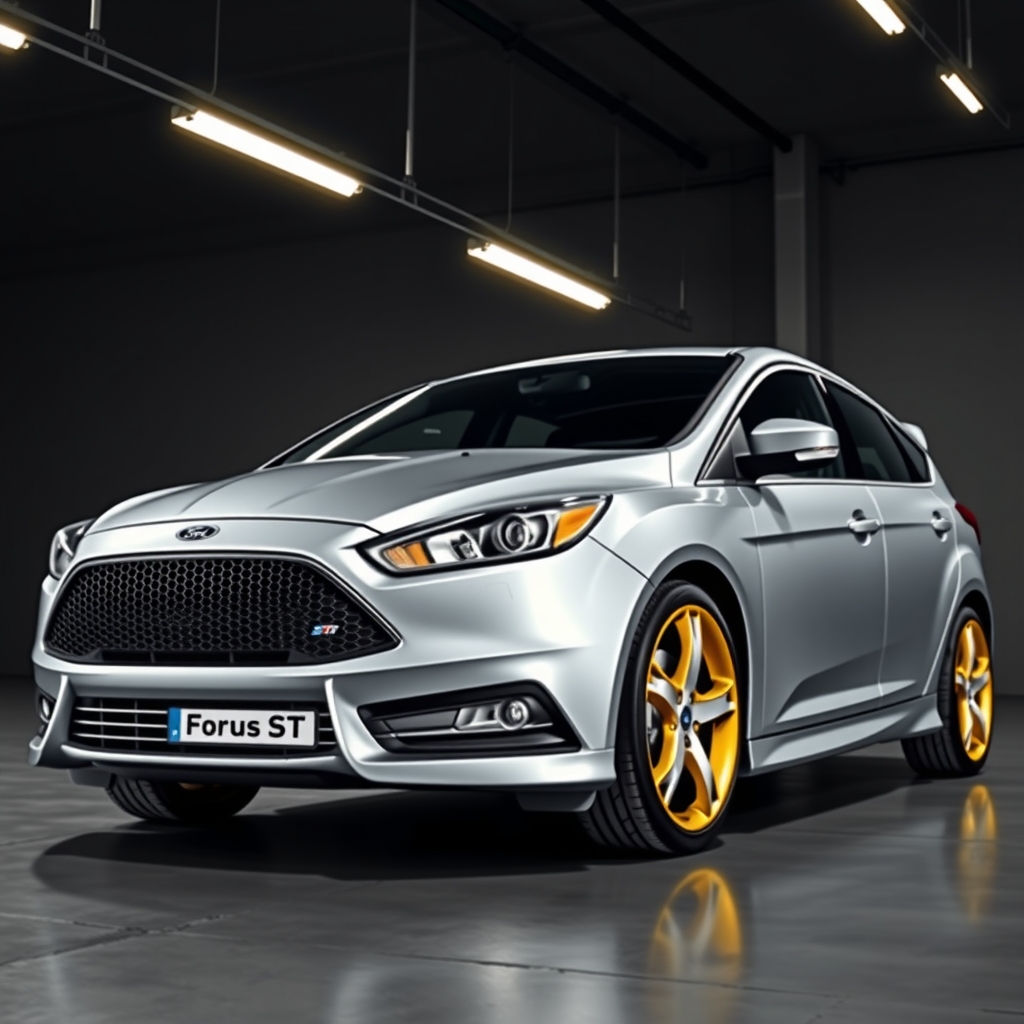
Ford Focus wheel fitment — ST III
Ford Focus wheel fitment
Ford Focus wheel fitment comes down to two things: the factory hub spec, and how far the aftermarket width and offset can move from it. Both are here for the Ford Focus ST (III) (2012–2018).
| Bolt pattern (PCD) | 5x10⁸ |
| Centre bore | 63.4 mm |
| Bolt / thread | M12x1.5 (nuts) |
| Wheel-bolt torque | 108 Nm |
| Seat type | tapered |
| Factory setup | square |
| TPMS | direct |
Aftermarket wheel sizes — read per position:
| Position | Width | Offset |
|---|---|---|
| Front | 6.5J–9J | ET35–ET55 |
Go wider and the offset has to rise with it, about 8 to 10 ET per extra 1J, or the wheel pokes past the arch. The fit-check settles the exact offset and any spacer.
Overview
The third generation Ford Focus (III) was produced from 2012 to 2018, marking a significant evolution of the compact car segment. It featured a cohesive international design and production strategy, with simultaneous launches in North America and Europe. The model offered sedan, hatchback, and estate body styles, along with the Active crossover-inspired variant and Vignale luxury trim level. Technological advancements included Sync 3 infotainment system, FordPass Connect, and CoPilot360 driver assistance features.
Engines & drivetrain
| Variant | Engine | Fuel | Power | Drive, years |
|---|---|---|---|---|
| 1.0 L Turbocharged GDI I3 | petrol | 123 hp | ||
| 2.0 L Ti-VCT GDI I4 | petrol | 160 hp | ||
| 2.0 L Ti-VCT GDI I4 PZEV engine (PZEV states) | petrol | 159 hp | ||
| 2.0 L Turbocharged GDI I4 engine (Focus ST) | petrol | 252 hp | ||
| 2.3 L Turbocharged GDI I4 engine (Focus RS) | petrol | 350 hp | ||
| 1.0 L EcoBoost | petrol | 74 kW (100 PS) | 2012 to 2019 | |
| 1.0 L EcoBoost | petrol | 92 kW (125 PS) | 2012 to 2019 | |
| 1.6 L Ti-VCT Duratec | petrol | 63 kW (85 PS) | ||
| 1.6 L Ti-VCT Duratec | petrol | 77 kW (105 PS) | ||
| 1.6 L Ti-VCT Duratec | petrol | 92 kW (125 PS) | ||
| 1.6 L EcoBoost | petrol | 110 kW (150 PS) | ||
| 1.6 L EcoBoost | petrol | 134 kW (182 PS) | ||
| 2.0 L EcoBoost | petrol | 184 kW (250 PS) | ||
| 1.6 L Duratorq | diesel | 70 kW (95 PS) | ||
| 1.6 L Duratorq | diesel | 85 kW (115 PS) | ||
| 1.6 L Duratorq Econetic | diesel | 77 kW (105 PS) | ||
| 2.0 L Duratorq | diesel | 85 kW (115 PS) | ||
| 2.0 L Duratorq | diesel | 103 kW (140 PS) | ||
| 2.0 L Duratorq | diesel | 120 kW (163 PS) |
Source: Ford Focus (third generation), en.wikipedia.org.
Performance
| Variant | Power | 0 to 62 mph (0 to 100 km/h) | Top speed |
|---|---|---|---|
| 1.0 L Turbocharged GDI I3 | 123 hp | 208 km/h (129 mph) | |
| 2.0 L Ti-VCT GDI I4 | 160 hp | 196 km/h (122 mph) | |
| 2.0 L Turbocharged GDI I4 engine (Focus ST) | 252 hp | 249 km/h (155 mph) | |
| 2.3 L Turbocharged GDI I4 engine (Focus RS) | 350 hp | 266 km/h (165 mph) | |
| 1.0 L EcoBoost | 74 kW (100 PS) | 12.5 s | 187 km/h (116 mph) |
| 1.0 L EcoBoost | 92 kW (125 PS) | 11.3 s | 195 km/h (121 mph) |
| 1.6 L Ti-VCT Duratec | 63 kW (85 PS) | 14.9 s | 170 km/h (106 mph) |
| 1.6 L Ti-VCT Duratec | 77 kW (105 PS) | 12.3 s | 187 km/h (116 mph) |
| 1.6 L Ti-VCT Duratec | 92 kW (125 PS) | 10.9 s | 195 km/h (121 mph) |
| 1.6 L EcoBoost | 110 kW (150 PS) | 8.6 s | 210 km/h (130 mph) |
| 1.6 L EcoBoost | 134 kW (182 PS) | 7.9 s | 222 km/h (138 mph) |
| 2.0 L EcoBoost | 184 kW (250 PS) | 6.5 s | 248 km/h (154 mph) |
| 1.6 L Duratorq | 70 kW (95 PS) | 12.5 s | 180 km/h (112 mph) |
| 1.6 L Duratorq | 85 kW (115 PS) | 10.9 s | 193 km/h (120 mph) |
| 1.6 L Duratorq Econetic | 77 kW (105 PS) | 11.8 s | 187 km/h (116 mph) |
| 2.0 L Duratorq | 85 kW (115 PS) | 10.9 s | 196 km/h (122 mph) |
| 2.0 L Duratorq | 103 kW (140 PS) | 8.9 s | 207 km/h (129 mph) |
| 2.0 L Duratorq | 120 kW (163 PS) | 8.6 s | 218 km/h (135 mph) |
Source: Ford Focus (third generation), en.wikipedia.org.
UK popularity & demand
Based on DfT VEH0124 vehicle-parc data (2025), there are approximately 886,255 Ford Focus on UK roads, placing it in the top 1% of car models by volume across our fitment database.
With that many on the road, Ford Focus wheel fitment is a spec fitters see constantly. We keep it current for that reason.
Source: DfT/DVLA licensed-vehicle statistics (VEH0124), matched to the AIWheelTech fitment database.
History & notable variants
The third generation Focus was introduced at the 2010 North American International Auto Show as a five-door hatchback with a new 2.0-litre direct injection engine. It marked a return to unified international design after previous generations diverged for different markets. The model received a facelift in 2014, incorporating Ford's latest family grille and slimline headlights. In motorsport, the Focus RS returned in 2015 with an advanced all-wheel drive system.
Dimensions
| Length | 4,358 to 4,556 mm |
| Width | 1,823 mm |
| Height | 1,484 to 1,505 mm |
| Wheelbase | 2,648 mm |
| Kerb weight | 1,270 to 1,471 kg |
Source: Ford Focus (third generation), en.wikipedia.org.
Body styles & production
| Body styles | 5-door hatchback, 4-door sedan, 5-door station wagon |
| Produced | 2012–2018 |
Trim levels
Factory colours
Reliability & owner notes
- Pros: Unified international design; advanced technology features; improved interior space
- Cons: No specific cons mentioned in the reference
- Common issues: None documented for this generation