
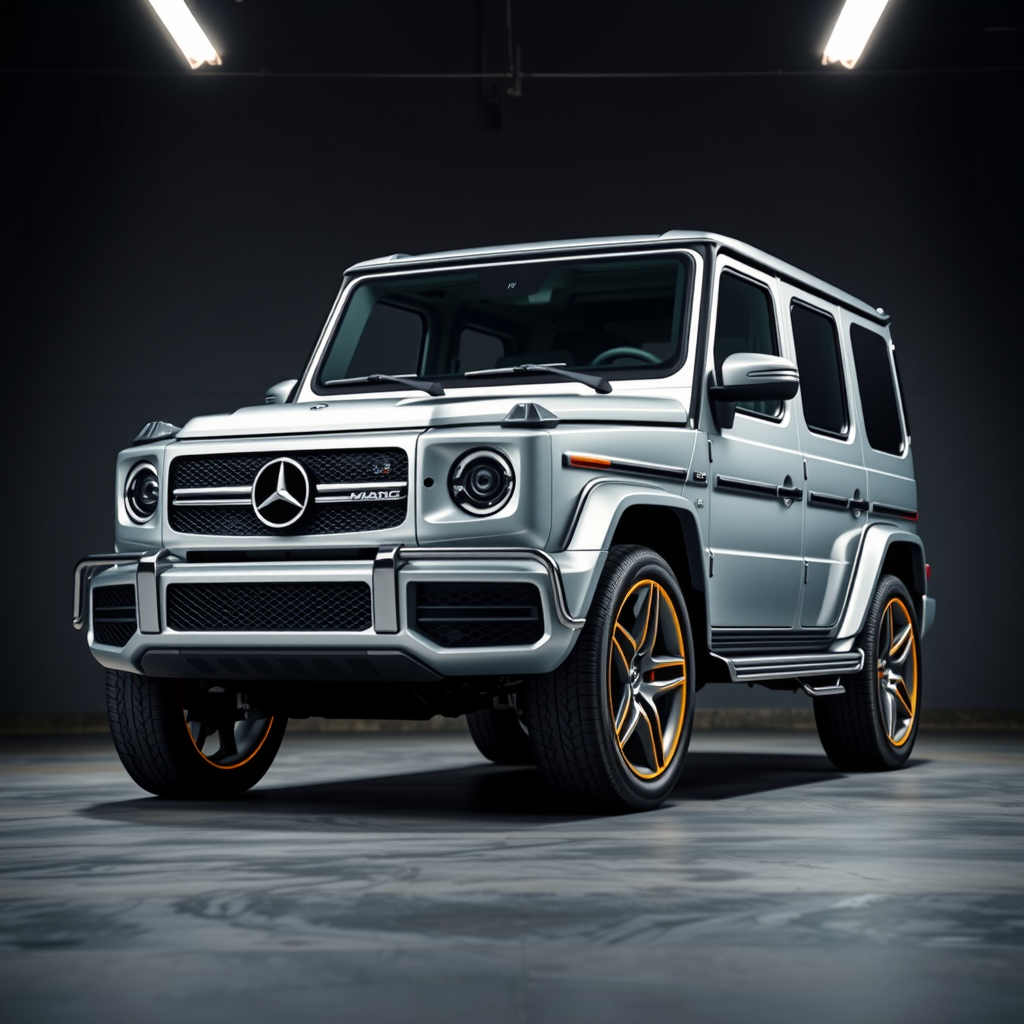
Mercedes G Class wheel fitment — G-Class 463 Facelift
Overview
The Mercedes-Benz G-Class, colloquially known as the G-Wagon or G-Wagen (as an abbreviation of Geländewagen), is a four-wheel drive luxury SUV sold by Mercedes-Benz. Originally developed as a military off-roader in 1972 and later offered as a civilian vehicle in 1979, it has evolved into one of Daimler's longest-produced vehicles with boxy styling and body-on-frame construction. Despite the introduction of an intended replacement, the unibody SUV Mercedes-Benz GL-Class in 2006, the G-Class remains in production. In 2018, a second-generation W463 was introduced with heavily revised chassis, powertrain, body, and interior.
Mercedes G Class wheel fitment
Mercedes G Class wheel fitment for the Mercedes G-Class 463 Facelift (1979–present): the factory PCD, centre bore and bolt spec, then the aftermarket width and offset window we fit to.
| Bolt pattern (PCD) | 5x130 |
| Centre bore | 84.1 mm |
| Bolt / thread | M14x1.5 (bolts) |
| Wheel-bolt torque | 130 Nm |
| Seat type | radius |
| Factory setup | square |
| TPMS | direct |
| Run-flat | Yes |
Aftermarket wheel sizes — read per position:
| Position | Width | Offset |
|---|---|---|
| Front | 7.5J–10J | ET20–ET50 |
As a rule, each extra 1J of width wants roughly +8–10 ET to keep the wheel tucked. The exact offset and any spacer are confirmed by the fit-check.
UK popularity & demand
Based on DfT VEH0124 vehicle-parc data (2025), there are approximately 1,469 Mercedes G Class on UK roads, placing it in the top 27% of car models by volume across our fitment database.
That makes Mercedes G Class wheel fitment a high-demand spec to keep in stock. It is one reason we track it here.
Source: DfT/DVLA licensed-vehicle statistics (VEH0124), matched to the AIWheelTech fitment database.
Engines & drivetrain
| Variant | Engine | Fuel | Power | Drive |
|---|---|---|---|---|
| 280 GE AMG | 2.7L M 110.994 | petrol | 134 hp | AWD |
| 280 GE | 2.7L M 110.994 | petrol | 115 hp | AWD |
| 230 GE 2.6 Brabus | 2.6L M 102.981 Brabus | petrol | 114 hp | AWD |
| 230 GE | 2.3L M 102.981 | petrol | 92 hp | AWD |
| 200 GE (Italy only) | 2.0L M 102.964 | petrol | 87 hp | AWD |
| 230 G | 2.3L M 115.973 | petrol | 66 hp | AWD |
| 300 GD | 2.9L OM 617 | diesel | 65 hp | AWD |
| 250 GD | 2.5L OM 602 | diesel | 62 hp | AWD |
| 240 GD | 2.4L OM 616 | diesel | 53 hp | AWD |
Performance
| Variant | Power | 0–62 mph | Top speed |
|---|---|---|---|
| 200 GE (Italy only) | 87 hp | 18 s | 93 mph |
| 230 G | 66 hp | 26 s | 80 mph |
| 230 GE | 92 hp | 17 s | 95 mph |
| 280 GE | 115 hp | 14 s | 103 mph |
| 230 GE 2.6 Brabus | 114 hp | 14.7 s | 98 mph |
| 280 GE AMG | 134 hp | 14 s | 103 mph |
| 240 GD | 53 hp | 32 s | 72 mph |
| 250 GD | 62 hp | 27 s | 80 mph |
| 300 GD | 65 hp | 27 s | 80 mph |
Dimensions
| Height | 3913 mm |
| Wheelbase | 2400 mm |
| Kerb weight | 3913 kg |
Body styles & production
| Body styles | SUV |
| Produced | 1979–present |
Trim levels
Factory colours
History & notable variants
The development of the G-Class started in 1972 with Daimler-Benz and Steyr-Daimler-Puch in Graz, Austria. The first drivable prototype began testing in 1974, and production commenced in 1975. By 1986, over 50,000 units had been produced. In 2018, the second-generation W463 was introduced with significant updates.
Reliability & owner notes
- Pros: Boxy styling, body-on-frame construction, three fully locking differentials
- Cons: High fuel consumption, limited passenger space