
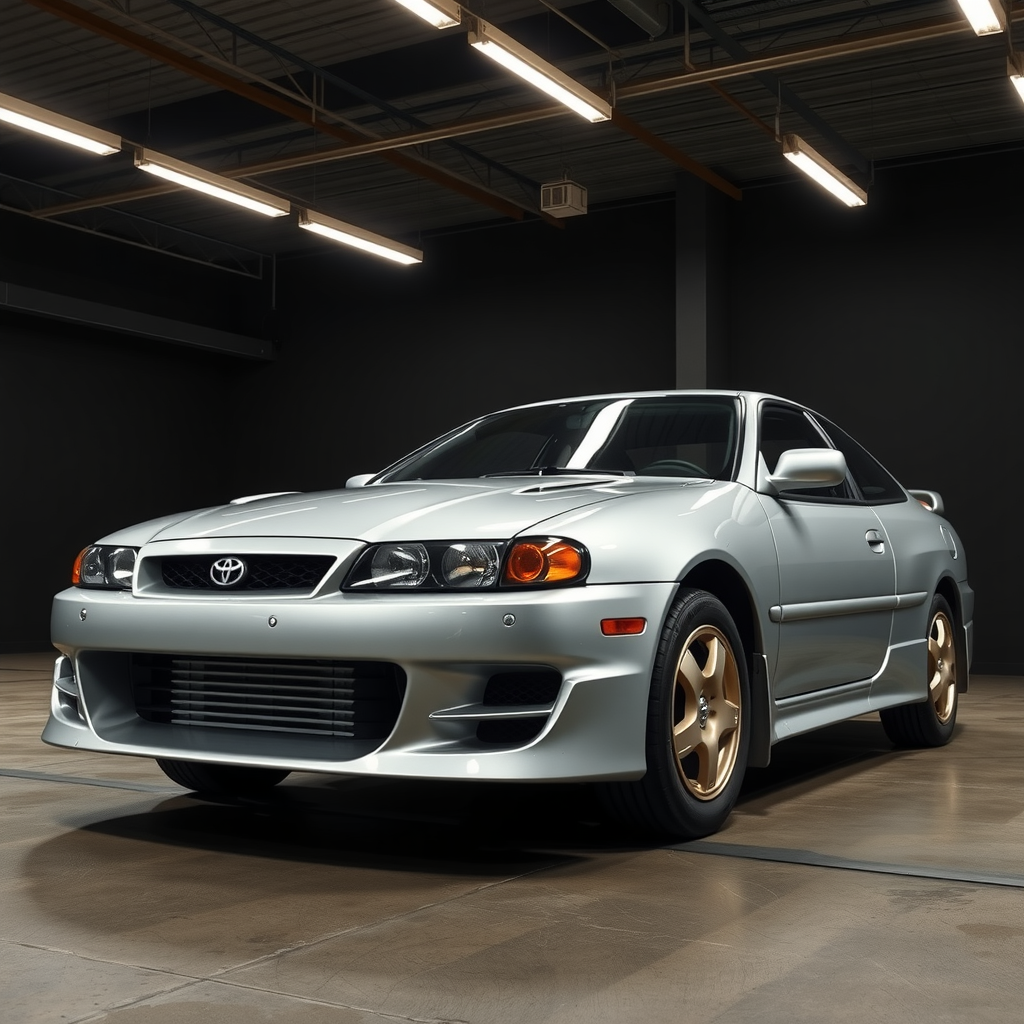
Toyota Celica wheel fitment — T23
Toyota Celica wheel fitment
Toyota Celica wheel fitment comes down to two things: the factory hub spec, and how far the aftermarket width and offset can move from it. Both are here for the Toyota Celica T23 (1970–2022).
| Bolt pattern (PCD) | 5X100 |
| Centre bore | 54.1 mm |
| Bolt / thread | M12x1.5 (nuts) |
| Seat type | flat |
| Factory setup | square |
| Brakes | e11*98/14*0122*..,e11*2001/116*0122*. |
| TPMS | none |
Aftermarket wheel sizes — read per position:
| Position | Width | Offset |
|---|---|---|
| Front | 6.5J–8.5J | ET28–ET40 |
As a rule, each extra 1J of width wants roughly +8 to 10 ET to keep the wheel tucked. The exact offset and any spacer are confirmed by the fit-check.
Overview
The Toyota Celica is a sports car produced by Toyota from 1970 until 2006. It was exclusive to Toyota Corolla Store dealerships in Japan and was based on the Corona platform, emphasizing styling and driving enjoyment. The first generation (A20, A30; 1970) featured two-door hardtop coupé and liftback body styles with front-engine, rear-wheel-drive layout. It was powered by various four-cylinder engines including the T series, 2T/2T-B, 2T-G, 8R, 18R, 18R-G, and 20R. The Celica's concept was to attach a coupe body to the chassis and mechanicals from a high-volume sedan like the Toyota Carina.
UK popularity & demand
Based on DfT VEH0124 vehicle-parc data (2025), there are approximately 6,371 Toyota Celica on UK roads, placing it in the top 17% of car models by volume across our fitment database.
With that many on the road, Toyota Celica wheel fitment is a spec fitters see constantly. We keep it current for that reason.
Source: DfT/DVLA licensed-vehicle statistics (VEH0124), matched to the AIWheelTech fitment database.
History & notable variants
The first generation of the Celica debuted at the October 1970 Tokyo Motor Show and was marketed from December that year. It underwent several updates, including changes in engine displacement regulations for Japan and safety equipment mandates for North America. The liftback model was introduced in April 1973 for the Japanese market and July 1974 for export markets. In August 1985, the car's drive layout changed from rear-wheel to front-wheel drive.
Body styles & production
| Produced | 1970–2022 |
Trim levels
Reliability & owner notes
- Pros: Styling and driving enjoyment emphasized; various engine options
- Cons: Early engines proved to be less than durable with early failures common
- Common issues: Engine durability issues in the 8R and 18R series