
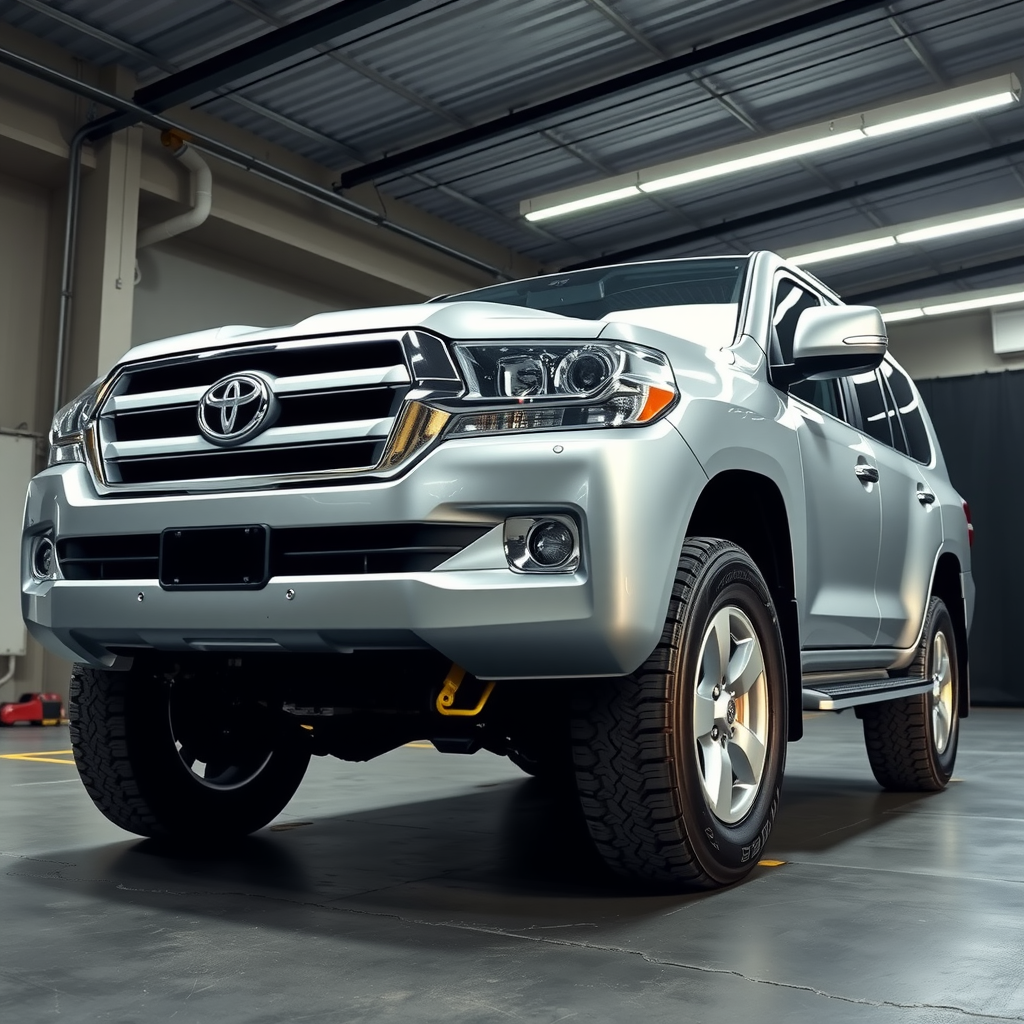
Toyota Landcruiser wheel fitment — 120
Toyota Landcruiser wheel fitment
Toyota Landcruiser wheel fitment comes down to two things: the factory hub spec, and how far the aftermarket width and offset can move from it. Both are here for the Toyota Landcruiser 120 (1951–present).
| Bolt pattern (PCD) | 6x139.7 |
| Centre bore | 106.1 mm |
| Bolt / thread | M12x1.5 (nuts) |
| Wheel-bolt torque | 115 Nm |
| Seat type | flat |
| Factory setup | square |
| Brakes | e6*2001/116*0112*..- V8 |
| TPMS | none |
Aftermarket wheel sizes — read per position:
| Position | Width | Offset |
|---|---|---|
| Front | 7J–10.5J | ET6–ET50 |
Width and offset move together: roughly 8 to 10 ET more for every extra 1J keeps the wheel inside the arch. Final offset and any spacer come from the fit-check.
Overview
The Toyota Land Cruiser is a series of four-wheel drive vehicles produced by the Japanese automobile manufacturer Toyota since 1951. It is known for its reliability and longevity, making it popular in markets such as Australia, Russia, and Africa where it serves various purposes including farming, construction, humanitarian aid, and military use. The REFERENCE does not specify exact production years or details specific to a particular generation (2003–2009) for this model.
UK popularity & demand
Based on DfT VEH0124 vehicle-parc data (2025), there are approximately 18,525 Toyota Landcruiser on UK roads, placing it in the top 11% of car models by volume across our fitment database.
With that many on the road, Toyota Landcruiser wheel fitment is a spec fitters see constantly. We keep it current for that reason.
Source: DfT/DVLA licensed-vehicle statistics (VEH0124), matched to the AIWheelTech fitment database.
History & notable variants
The Land Cruiser has been extensively tested in the Australian outback, known as one of the toughest operating environments. Since 1990, a smaller variation called the Land Cruiser Prado was marketed separately, and in 2025, an even smaller version named Land Cruiser FJ was introduced.
Body styles & production
| Produced | 1951–present |
Factory colours
Reliability & owner notes
- Pros: Reliability, longevity, versatility in various terrains and uses
- Cons: Lack of specific details for the 120 generation (2003–2009) from the REFERENCE
- Common issues: Not specified for this generation