
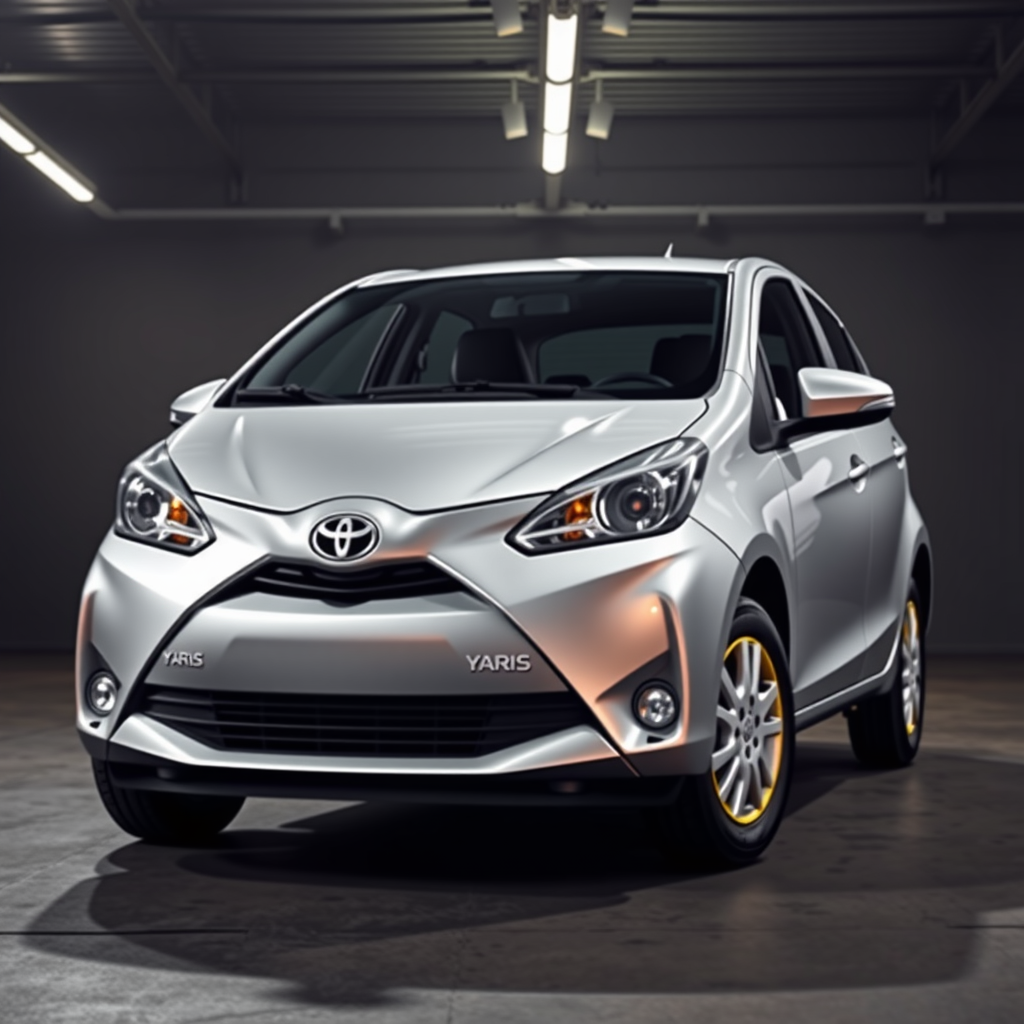
Toyota Yaris wheel fitment — III XP130
Overview
The Toyota Yaris XP130 is the third generation of the subcompact car, marketed globally from 2011. Initially available as a hatchback, it was joined by a sedan variant in 2013. The European, Australasian, South African and most North American versions derive from the Japanese market Toyota Vitz (XP130), introduced early 2011. Most Asian versions from 2013 onwards, some Latin American and Caribbean models from 2014, and South African models from early 2018 derive from the Asian market Toyota Yaris (XP150).
Toyota Yaris wheel fitment
Start with the hub. The Toyota Yaris (III) XP130 spec table gives the bolt pattern and bore; the second table is the aftermarket window for Toyota Yaris wheel fitment.
| Bolt pattern (PCD) | 4x100 |
| Centre bore | 54.1 mm |
| Bolt / thread | M12x1.5 (nuts) |
| Seat type | flat |
| Factory setup | square |
| Brakes | e11*2007/46*0152*..;e13*2007/46*1722*..;e6*2007/46*0344*..- incl. Facelift 2017 |
| TPMS | direct |
Aftermarket wheel sizes — read per position:
| Position | Width | Offset |
|---|---|---|
| Front | 5J–7.5J | ET25–ET52 |
As a rule, each extra 1J of width wants roughly +8 to 10 ET to keep the wheel tucked. The exact offset and any spacer are confirmed by the fit-check.
UK popularity & demand
Based on DfT VEH0124 vehicle-parc data (2025), there are approximately 583,070 Toyota Yaris on UK roads, placing it in the top 1% of car models by volume across our fitment database.
That makes Toyota Yaris wheel fitment a high-demand spec to keep in stock. It is one reason we track it here.
Source: DfT/DVLA licensed-vehicle statistics (VEH0124), matched to the AIWheelTech fitment database.
Engines & drivetrain
| Variant | Engine | Fuel | Power | Drive |
|---|---|---|---|---|
| 1.5L VVT-i TRD | 1.5L inline-4 petrol engine with performance tuning | petrol | 138 hp | FWD |
| 1.5L VVT-i TRD Hybrid | 1.5L inline-4 petrol engine with electric motor and performance | hybrid | 138 hp | FWD |
| 1.5L VVT-i TRD 4WD | 1.5L inline-4 petrol engine with all-wheel drive system and perf | petrol | 138 hp | AWD |
| 1.5L VVT-i Hybrid | 1.5L inline-4 petrol engine with electric motor | hybrid | 116 hp | FWD |
| 1.5L VVT-i | 1.5L inline-4 petrol engine | petrol | 103 hp | FWD |
| 1.5L VVT-i 4WD | 1.5L inline-4 petrol engine with all-wheel drive system | petrol | 103 hp | AWD |
| 1.3L VVT-i | 1.3L inline-4 petrol engine | petrol | 98 hp | FWD |
| 1.3L VVT-i Hybrid | 1.3L inline-4 petrol engine with electric motor | hybrid | 98 hp | FWD |
| 1.2L VVT-i Hybrid | 1.2L inline-4 petrol engine with electric motor | hybrid | 98 hp | FWD |
| 1.3L VVT-i 4WD | 1.3L inline-4 petrol engine with all-wheel drive system | petrol | 98 hp | AWD |
| 1.2L VVT-i | 1.2L inline-4 petrol engine | petrol | 83 hp | FWD |
| 1.0L VVT-i | 1.0L inline-3 petrol engine | petrol | 69 hp | FWD |
Performance
| Variant | Power | 0–62 mph | Top speed |
|---|---|---|---|
| 1.5L VVT-i | 103 hp | 8.7 s | 112 mph |
| 1.5L VVT-i Hybrid | 116 hp | 9.3 s | 107 mph |
| 1.0L VVT-i | 69 hp | 12.4 s | 105 mph |
| 1.3L VVT-i | 98 hp | 10.7 s | 115 mph |
| 1.3L VVT-i Hybrid | 98 hp | 10.7 s | 115 mph |
| 1.5L VVT-i TRD | 138 hp | 7.9 s | 120 mph |
| 1.5L VVT-i TRD Hybrid | 138 hp | 7.9 s | 120 mph |
| 1.2L VVT-i | 83 hp | 11.5 s | 110 mph |
| 1.2L VVT-i Hybrid | 98 hp | 10.7 s | 115 mph |
| 1.3L VVT-i 4WD | 98 hp | 10.7 s | 115 mph |
| 1.5L VVT-i 4WD | 103 hp | 8.7 s | 112 mph |
| 1.5L VVT-i TRD 4WD | 138 hp | 7.9 s | 120 mph |
Body styles & production
| Body styles | Hatchback, Sedan |
| Produced | 2011–2014 |
Trim levels
History & notable variants
The XP130 generation was introduced in Japan and Europe in 2011. It saw a facelift for some markets in 2014, with minor updates to styling and features. In North America, production shifted from Japan to France starting May 2013. The sedan variant arrived globally in 2013 but was not offered in the US or Canada due to market preferences.
Reliability & owner notes
- Pros: null
- Cons: null
- Common issues: null