
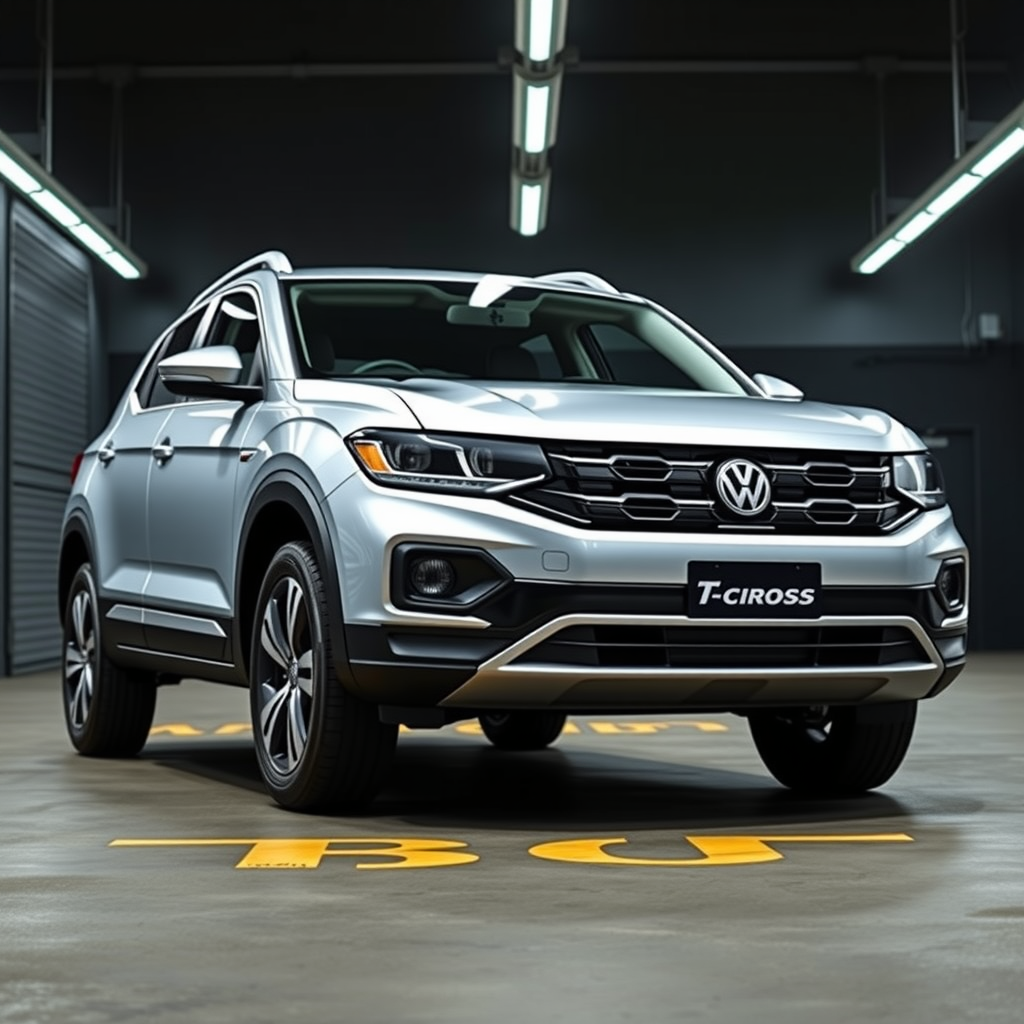
Volkswagen T-Cross wheel fitment — C1
Overview
The Volkswagen T-Cross is a subcompact crossover SUV (B-segment) manufactured by Volkswagen. It is based on the MQB A0 platform shared with the Polo Mk6 and was officially launched in April 2019. Positioned below the T-Roc, it acts as an entry-level model for Europe and targets young families and older demographics due to its practicality and high driving position. The production version was first unveiled simultaneously in Amsterdam, Shanghai, and São Paulo on October 25, 2018.
Volkswagen T-Cross wheel fitment
Volkswagen T-Cross wheel fitment for the Volkswagen T-Cross C1 (2018–present): the factory PCD, centre bore and bolt spec, then the aftermarket width and offset window we fit to.
| Bolt pattern (PCD) | 5x100 |
| Centre bore | 57.1 mm |
| Bolt / thread | M14x1.5 (bolts) |
| Wheel-bolt torque | 120 Nm |
| Seat type | radius |
| Factory setup | square |
| TPMS | indirect |
Aftermarket wheel sizes — read per position:
| Position | Width | Offset |
|---|---|---|
| Front | 6J–8.5J | ET25–ET40 |
As a rule, each extra 1J of width wants roughly +8–10 ET to keep the wheel tucked. The exact offset and any spacer are confirmed by the fit-check.
UK popularity & demand
Based on DfT VEH0124 vehicle-parc data (2025), there are approximately 54,548 Volkswagen T-Cross on UK roads, placing it in the top 6% of car models by volume across our fitment database.
That makes Volkswagen T-Cross wheel fitment a high-demand spec to keep in stock. It is one reason we track it here.
Source: DfT/DVLA licensed-vehicle statistics (VEH0124), matched to the AIWheelTech fitment database.
Engines & drivetrain
| Variant | Engine | Fuel | Power | Drive |
|---|---|---|---|---|
| 1.5 250 TSI | 1.5L Turbocharged Stratified Injection I4 | petrol | 152 hp | FWD |
| 1.5 TSI 150 | 1.5L Turbocharged Stratified Injection I4 | petrol | 150 hp | FWD |
| 1.4 TSI '280 TSI' | 1.4L Turbocharged Stratified Injection I4 | petrol | 150 hp | FWD |
| 1.0 200 TSI (petrol) | 1.0L Turbocharged Stratified Injection I3 | petrol | 118 hp | FWD |
| 1.0 TSI 115 | 1.0L Turbocharged Stratified Injection I3 | petrol | 115 hp | FWD |
| 1.5 MPI | 1.5L Multi-point Injection I4 | petrol | 115 hp | FWD |
| 1.6 MSI | 1.6L Multi-point Injection I4 | petrol | 112 hp | FWD |
| 1.0 TSI 95 | 1.0L Turbocharged Stratified Injection I3 | petrol | 95 hp | FWD |
| 1.6 TDI 95 | 1.6L Turbodiesel I4 | diesel | 95 hp | FWD |
Performance
| Variant | Power | 0–62 mph | Top speed |
|---|---|---|---|
| 1.0 TSI (94 hp) | 94 hp | ||
| 1.0 TSI (113 hp) | 113 hp | ||
| 1.4 TSI | 150 hp |
Dimensions
| Length | 4108 mm |
| Width | 1760 mm |
| Height | 1583 mm |
| Wheelbase | 2551 mm |
| Kerb weight | 1245 kg |
Body styles & production
| Body styles | 5-door SUV |
| Produced | 2018–present |
| Units produced | 693,611 |
Trim levels
Factory colours
History & notable variants
The development of the T-Cross began as a replacement for a cancelled project based on the Volkswagen Taigun concept showcased in 2012. It is an SUV derived from the Volkswagen Up! with a length under 3.9 m destined for Europe, Brazil, and India. The production version was officially launched in April 2019 after being previewed as a concept car called T-Cross Breeze at the Geneva Motor Show in 2016.
Reliability & owner notes
- Pros: Practical and family-oriented design; wide range of engine options; available in multiple markets with localized variants
- Cons: Limited to front-wheel drive only; boot capacity reduced compared to European version due to longer wheelbase models